
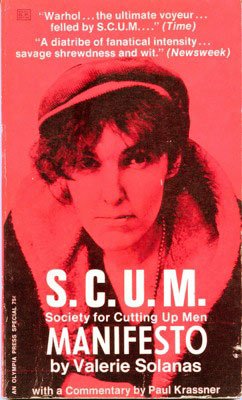
SCUM Manifesto was considered one of the most outrageous, violent and certifiably crazy tracts when it first appeared in 1968. Valerie Solanas, the woman who shot Andy Warhol, self-published this work just before her rampage against the king of Pop Art made her a household name and resulted in her confinement to a mental institution. But the Manifesto, for all its vitriol, is impossible to dismiss as just the rantings of a lesbian lunatic. In fact, the work has indisputable prescience, not only as a radical feminist analysis light-years ahead of its timepredicting artificial insemination, ATMs, a feminist uprising against under-representation in the artsbut also as a stunning testament to the rage of an abused and destitute woman.
The now legendary Dialectics of Liberation congress, held in London in 1967, was a unique expression of the politics of dissent. Existential psychiatrists, Marxist intellectuals, anarchists, and political leaders met to discuss key social issues. Edited by David Cooper, The Dialectics of Liberation compiles interventions from congress contributors Stokely Carmichael, Herbert Marcuse, R. D. Laing, Paul Sweezy, and others, to explore the roots of social violence. Against a backdrop of rising student frustration, racism, class inequality, and environmental degradation—a setting familiar to readers today—the conference aimed to create genuine revolutionary momentum by fusing ideology and action on the levels of the individual and of mass society. The Dialectics of Liberation captures the rise of a forceful style of political activity that came to characterize the following years.
The Labour Party has virtually disappeared from view under the leadership of Keir Starmer. Hailed as a human-rights champion and political outsider, what sort of politician is Keir Starmer really, and what mark is he making on the new politics of Labour? In The Starmer Project, Oliver Eagleton provides a careful reading of Starmer’s record at the Crown Prosecution Service and as a member of Jeremy Corbyn’s Shadow Cabinet, tracing the political alliances he forged and the roots of his bid for the Party leadership. Starmer originally pledged to revitalise Corbynism with a dose of lawyerly competence. To understand what happened afterwards it is necessary to understand the man himself. So little remains known about Starmer that his actions are usually interpreted as overtures to others. On closer inspection, however, he is anything but an empty political vessel.

Frantz Fanon's The Wretched of the Earth is a masterful and timeless interrogation of race, colonialism, psychological trauma, and revolutionary struggle, and a continuing influence on movements from Black Lives Matter to decolonization. A landmark text for revolutionaries and activists, The Wretched of the Earth is an eternal touchstone for civil rights, anti-colonialism, psychiatric studies, and Black consciousness movements around the world.
Tools for Conviviality is a 1973 book by Ivan Illich about the proper use of technology. It was published only two years after his previous book Deschooling Society. In this new work Illich generalized the themes that he had previously applied to the field of education: the institutionalization of specialized knowledge, the dominant role of technocratic elites in industrial society, and the need to develop new instruments for the reconquest of practical knowledge by the average citizen. He wrote that "[e]lite professional groups … have come to exert a 'radical monopoly' on such basic human activities as health, agriculture, home-building, and learning, leading to a 'war on subsistence' that robs peasant societies of their vital skills and know-how. The result of much economic development is very often not human flourishing but 'modernized poverty', dependency, and an out-of-control system in which the humans become worn-down mechanical parts." Illich proposed that we should "invert the present deep structure of tools" in order to "give people tools that guarantee their right to work with independent efficiency."